

When dealing with a health condition, or simply looking for ways to advance modern medicine, you may have heard the term "clinical trial." But what exactly does it mean to participate in one?
Far from being a "last resort," joining a clinical research study is a proactive choice. It offers the unique opportunity to access cutting-edge, investigational treatments, receive highly focused medical care, and play a vital role in medical breakthroughs that could help millions.
In this clinical trials guide, we will demystify clinical trials. We will cover how they work, the safety measures in place to protect you, what to expect during the process, and how to decide if participating is right for you.

What is a Clinical Trial?
At its core, a clinical trial is a carefully designed research study that tests how well new medical approaches work in people. Before any new medication, medical device, or therapy is made available to the general public, it must undergo rigorous testing to ensure it is both safe and effective.
To ensure safety and gather precise data, clinical research is broken down into four distinct phases. A new treatment must successfully pass one phase before moving on to the next.
The 4 Phases of Clinical Research
| Phase | Core Purpose | Typical Participant Count | Average Duration |
|---|---|---|---|
| Phase I | Evaluates the treatment's safety, identifies side effects, and determines a safe dosage range. | 20 to 100 healthy volunteers | Several months |
| Phase II | Measures the treatment's effectiveness for a specific condition and continues to monitor safety. | Up to several hundred people with the condition | Several months to 2 years |
| Phase III | Confirms efficacy, monitors side effects, and compares the new treatment to the current standard of care. | 300 to 3,000 volunteers | 1 to 4 years |
| Phase IV | Tracks long-term safety, risks, and real-world impact after the treatment has been approved for public use. | Thousands of real-world patients | Ongoing |
Clinical Trials Guide: Why Participate & Key Benefits
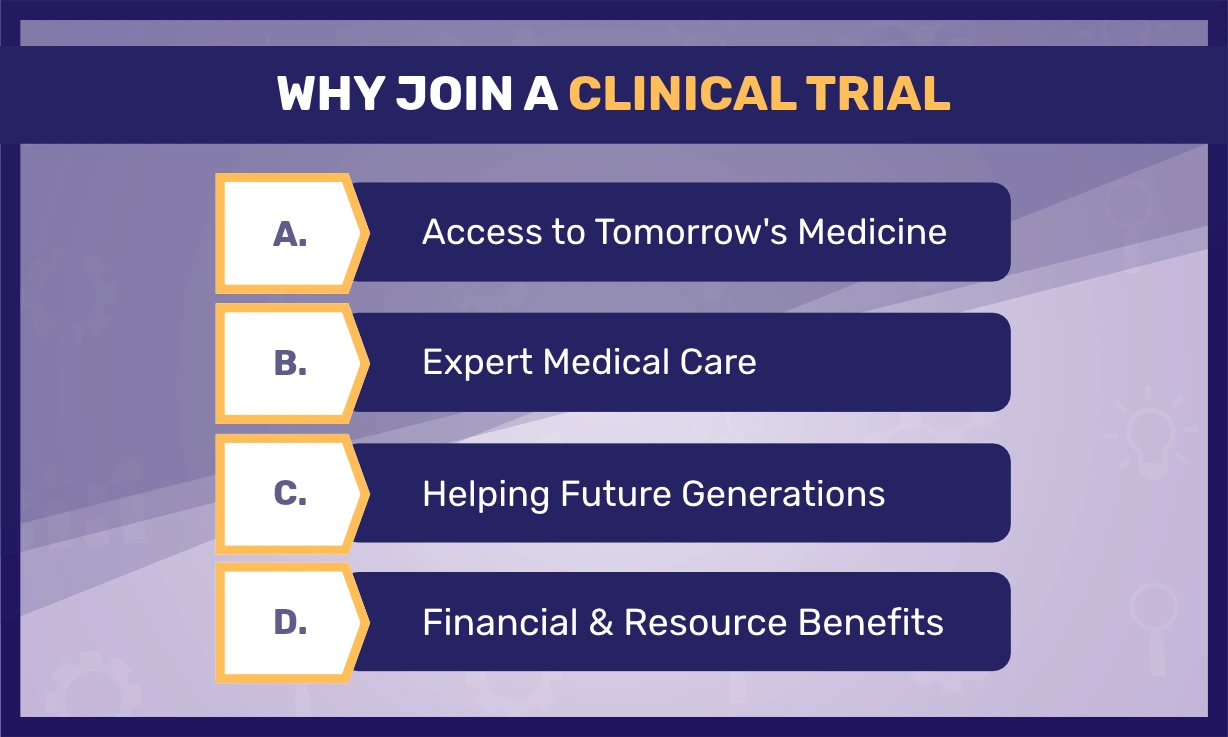
People choose to participate in clinical research for a variety of reasons. Whether you are motivated by your own health journey or a desire to help others, there are several distinct benefits to becoming a volunteer:
- Access to Tomorrow's Medicine: You may gain access to new, investigational treatments and therapies long before they are available to the general public or at your local pharmacy.
- Expert Medical Care: Throughout the trial, you will be closely monitored by a specialized team of doctors, nurses, and research professionals who are experts in your specific condition.
- Helping Future Generations: Without volunteers, medical progress would come to a halt. Your participation directly contributes to breakthroughs that could save or improve lives in the future.
- Financial and Resource Benefits: In most cases, study-related medical care, testing, and investigational medications are provided at no cost. Furthermore, many studies offer compensation to reimburse you for your time and travel expenses.
The Participant Journey: What to Expect
The idea of participating in a medical study can feel intimidating if you’re not sure what to expect. At Eximia Research, we ensure that the process is entirely transparent. Here is the typical step-by-step journey:
1. Finding & Choosing a Study
The journey begins by browsing open studies. You can search based on your specific medical condition, your age, or your location to find a trial that matches your profile.
2. Pre-Screening & Eligibility
Every clinical trial has strict "inclusion and exclusion criteria." A quick phone call or online questionnaire will help determine if you are a good potential match.
3. Informed Consent
Before you do anything, you will have a private discussion with the research team. You only sign the document if you feel completely comfortable moving forward.
4. The Baseline Visit
If you consent to participate, your first official study visit will involve a comprehensive health check, blood work, or physical exams to establish your baseline health.
5. Active Participation
During the active phase, you will follow the study’s specific protocol. This might involve taking investigational medication and attending regular appointments at the clinic.
6. Study Follow-Up
Even after the active treatment phase ends, the research team will continue to check in with you for a designated period to ensure your ongoing health and safety.
Your Safety, Rights, and Patient Protections
Your health and safety are the top priorities in any clinical trial. The clinical research industry is highly regulated, and strict safeguards are built into every level of a study.
- Institutional Review Boards (IRBs): Every clinical trial must be reviewed and approved by an IRB. This is an independent committee of doctors, statisticians, and community advocates whose sole job is to protect the rights and welfare of human volunteers.
- Strict Regulatory Standards: Trials are heavily monitored by regulatory agencies, such as the FDA, to ensure they adhere to strict scientific and ethical guidelines.
- Your Right to Leave: Participation is 100% voluntary. You are never locked into a trial. You have the right to withdraw your consent and leave the study at any time, for any reason, with no penalty or impact on your standard medical care.
Top Frequently Asked Questions (FAQ)
It is completely normal to have questions before signing up. Here are answers to some of the most common concerns patients have:
Are there any costs to participate in a trial?
No. You do not have to pay to participate in a clinical trial. All study-related care, including physical exams, laboratory tests, and investigational medication, is provided at no cost to you.
Do I get paid for participating?
While you are not "paid" a salary, participants are typically compensated for their time and travel. The specific amount varies depending on the requirements and duration of the study, and all compensation details will be outlined clearly during the informed consent process.
Is health insurance required?
No, you do not need health insurance to participate in our clinical trials. Because all study-related medical care and testing are covered by the trial sponsor, your insurance status does not impact your eligibility.
Will I just receive a sugar pill (placebo)?
Not necessarily. A placebo looks like the investigational treatment but contains no active ingredients. They are sometimes used in trials to compare against the real treatment. However, you will always be informed during the consent process if a placebo is part of the study design. In many cases, participants receive either the new treatment or the current standard-of-care medication.
Am I locked into a clinical trial once it begins?
Absolutely not. Joining a study is entirely voluntary from start to finish. You retain the right to withdraw from a trial at any point, for any reason, without having to explain yourself.
Have more questions about the screening process, standard medications, or data privacy? We cover over a dozen additional common queries on our full Clinical Trial FAQ Page.
Ready to Take the Next Step?
Medical advancements simply cannot happen without the willingness and dedication of clinical trial volunteers. By participating, you take an active role in your own healthcare while paving the way for better treatments for everyone.
If you are ready to explore your options, we are here to help you navigate the process safely and confidently.
